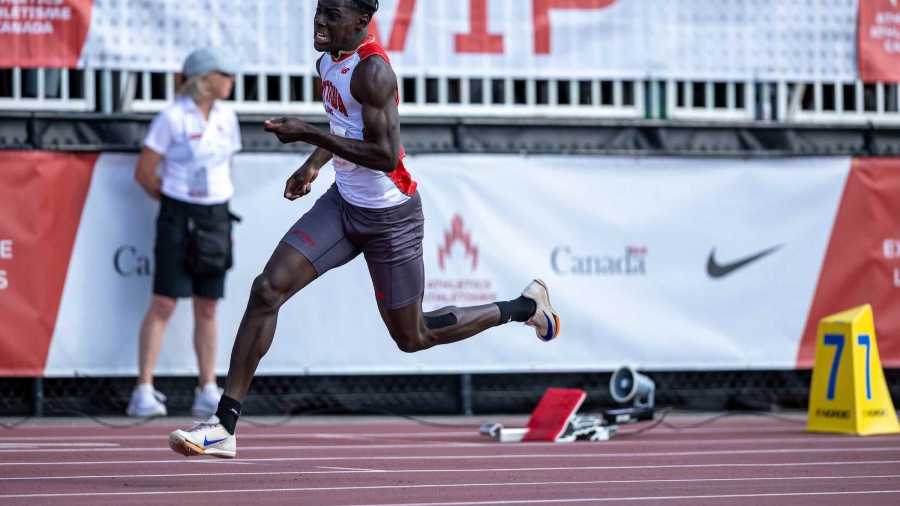
On a warm August afternoon in Calgary, Maxime Cazabon stood at the edge of the high jump apron, the bar set just shy of two metres. At 15 years old, the Garneau student already had multiple national titles to his name, rewritten club age-group records, and emerged as one of the most exciting young talents in the country. But this attempt carried added weight. Only one Lion in history had ever cleared higher at his age.
Cazabon took his approach, rose cleanly off the ground, and floated over 1.96 metres.
It was a moment that captured the essence of the 2025 season for the next generation of Lions athletes: the future didn’t wait its turn.
Emergence, Not Anticipation
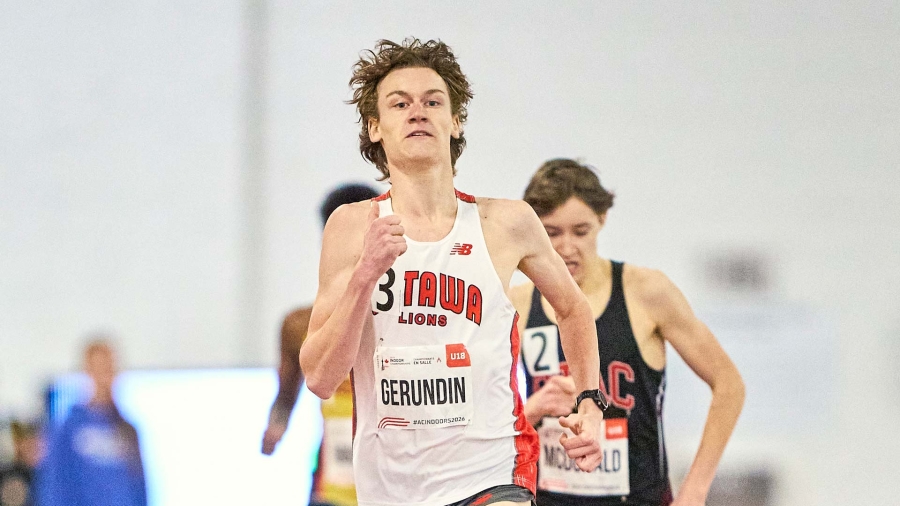
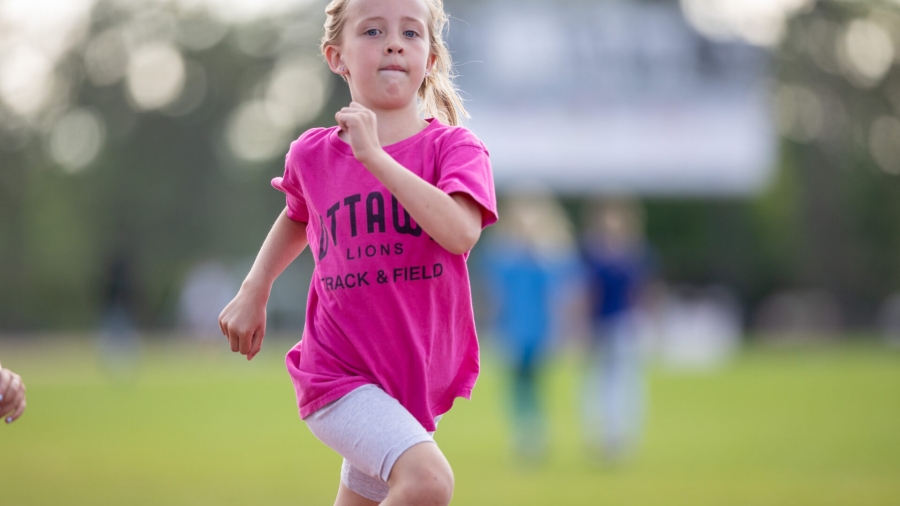
While Part One of the Lions’ 2025 Year in Review highlighted performances on the world’s biggest stages, the story beneath it was just as compelling. Across youth and junior competition, Lions athletes didn’t merely develop – they arrived, producing results that reshaped record books and accelerated timelines.
Cazabon was emblematic of that surge. Over the course of the year, he claimed three national championships, established himself as Canada’s top U16 high jumper, became the first Lion his age to surpass the 13-metre barrier in the triple jump, and broke Club speed barriers. By season’s end, his marks put him shoulder to shoulder with marks set by Olympians decades earlier, a rare position for an athlete still early in high school.
Collective Speed, National Impact
If Cazabon’s season illustrated what individual talent can become, the U20 men’s 4×400 metre relay showed what happens when that talent is assembled with intent.
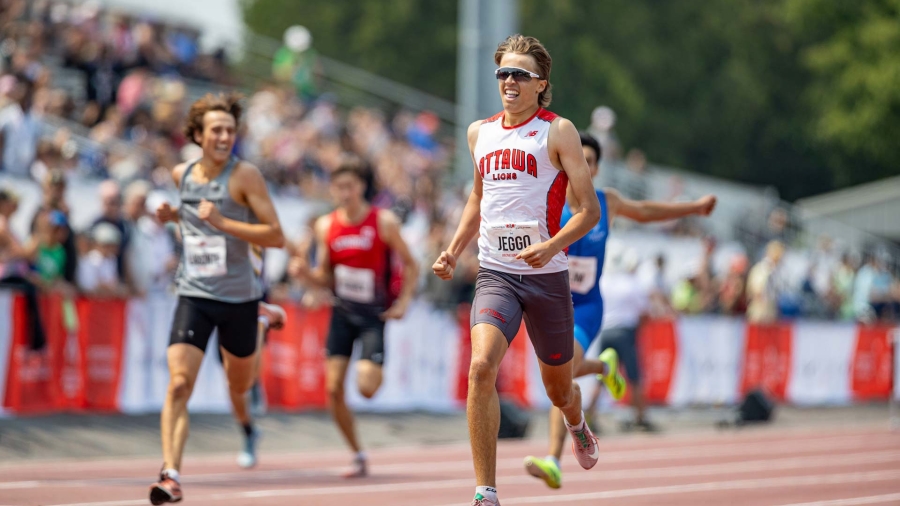
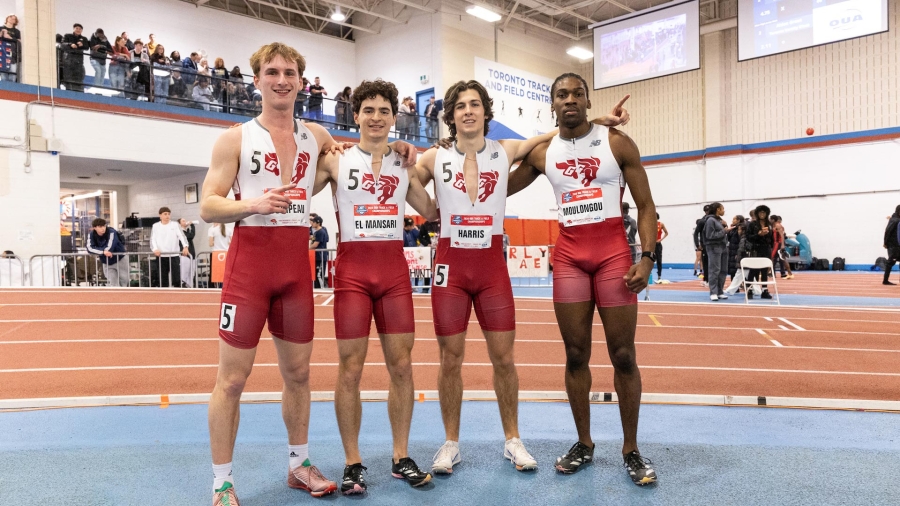
Over the course of 2025, Zachary Jeggo, Ayoub Shangai, Ange-Mathis Kramo, and William Sanders evolved from a promising quartet into one of the country’s most formidable relay units, culminating in a series of record-breaking performances that rewrote club and national benchmarks.
The defining moment came at the Canadian Championships in Ottawa, where the Lions stormed to gold in a stunning 3:10.62, obliterating their own Canadian U20 club record while also surpassing existing U23 and Open Canadian Club records. The performance ranked 25th in the world among U20 relay squads in 2025, a rare distinction for a Canadian club team.
More than the time itself, the relay’s success reflected the depth of the group. Jeggo anchored the quartet as one of the country’s most complete quarter-milers, lowering the Club U20 record to 46.62 and narrowly missing the Canadian high school record in the 400-metre hurdles with a 51.76 earlier in the season. Alongside him, Kramo (47.33) and Shangai (47.39) emerged as two of the world’s top U18 400-metre runners, ranking 41st and 45th globally in their age group. Together, they embodied a central theme of the Lions’ year: the future was arriving in full formation.
Speed Forged Through Pressure
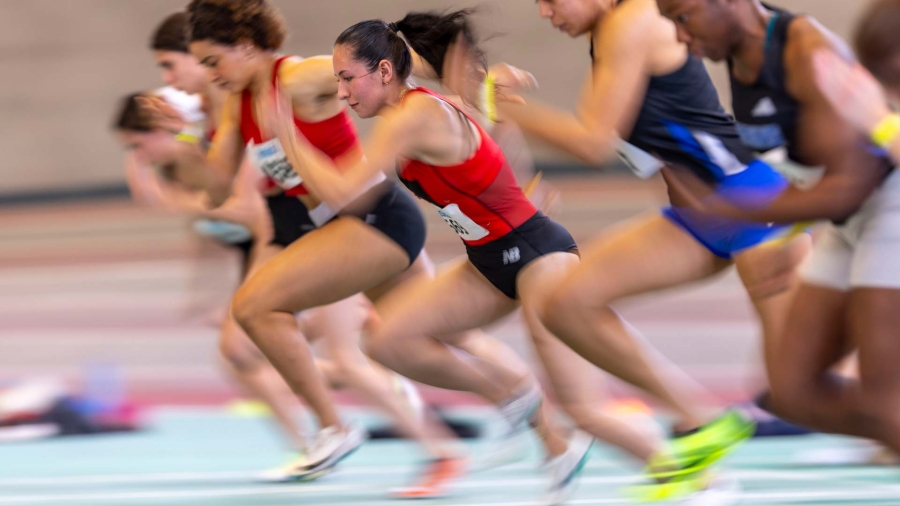
On the track, Jorai Oppong-Nketiah delivered one of the defining performances of the Lions’ 2025 season – not just through speed, but through timing.
Racing in front of a home crowd at the Canadian Championships, she completed the elusive Canadian U20 sprint double, capturing gold in both the 100 and 200 metres. Her winning times, 11.44 and 23.54, ranked 13th and 22nd in the world respectively among U18 athletes – a demonstration of peak performance when it mattered most.
The victories carried historical weight. The 100-metre title marked Oppong-Nketiah’s second consecutive Canadian U20 crown, moving her within one of equalling the national record of three straight titles set by Saskatchewan’s Jenni Hucul.
Still early in her career, Oppong-Nketiah’s place in that conversation underscores a defining theme of 2025: emerging athletes weren’t just collecting medals – they were positioning themselves within the sport’s historical arc.
Racing Without Fear
If Oppong-Nketiah showcased explosive speed under pressure, Daniel Cova illustrated the same composure at the opposite end of the spectrum.
At the Canadian Championships, Daniel Cova announced himself as a rising force in Canadian middle-distance running, earning U20 silver in the 5,000 metres with a lifetime best 14:24.11 that moved him to second on the club’s all-time U20 list behind Olympian Mike Woods. He returned later in the meet to add bronze in the 1,500 metres, capping a season of rapid progression in which he lowered his personal best by more than 12 seconds to 3:47.95, now seventh all-time among Lions U20 athletes, all with another full year of U20 competition still ahead.
Technical Precision and Rapid Progression
Eli Mordel spent much of 2025 doing what he does best: finding obstacles and clearing them.
The U18 standout captured double bronze indoors at the Canadian U18 Championships before becoming the first U18 Lion to break eight seconds in the 60-metre hurdles. Outdoors, he added another milestone, setting a new Club U18 record of 14.00 seconds in the 110-metre hurdles at the Royal Canadian Legion Championships.
True to form, his range extended beyond the hurdles. Mordel cleared a personal-best 4.30 metres in the pole vault at the Canadian U20 Championships, moving to second on the club’s all-time U18 list – further proof that obstacles were rarely more than temporary inconveniences.
Even as a late addition to the Lions, Anabelle Muir wasted little time making her presence felt. In just her first two competitions, she became the first U16 woman in club history to clear three metres before quickly raising the bar to 3.30 metres, establishing herself as one of Canada’s most promising young vaulters.
Earning the Maple Leaf
Momentum extended beyond the oval as well. Saul Taler delivered one of the Lions’ most significant distance performances of the year, earning selection to Team Canada for the upcoming World Athletics Cross Country Championships.
Competing in the U20 men’s 8km, Taler finished 11th overall on a demanding course, becoming the first Lions male to qualify for a World Cross Country team since Allan Brett in 2006.
From High School to the Next Level
One of the clearest indicators of the Lions’ developmental strength in 2025 was the number of athletes transitioning successfully to the university ranks.
This fall, Daniel Cova began his studies at Iona University, Grace Streek enrolled at Miami University, Zachary Jeggo joined Simon Fraser University, and Quinn Coughlin headed to Colorado State. Closer to home, Kaiya Woodcock embraced a two-sport role at the University of Guelph, Mason Brennan took his talents to the University of Toronto, while Saul Taler, Tessa Knight, and Juliette Murchison attended Queen’s University. Others, including Timeo Atonfo, Kyle London, and Amy Zhang, remained in Ottawa at the University of Ottawa.
Looking ahead, Oppong-Nketiah has committed to the University of Kentucky, while Canadian javelin champion Mallea McMullin plans to attend Clarkson University for hockey, following in footsteps of former Lions shot putter Dominique Thibault.
Momentum, Measured
By the close of 2025, the Ottawa Lions’ future was no longer theoretical.
Young athletes weren’t waiting behind senior success – they were contributing alongside it, rewriting records, stepping onto national podiums, and accelerating toward international relevance.
And if Maxime Cazabon’s clearance in Calgary was any indication, the next era of Ottawa Lions excellence isn’t approaching quietly.
It’s already in the air.